Episode credits Research, writing and hosting: Dave Cawley Audio production and mastering: Aaron Mason Cold main score composition: Michael Bahnmiller KSL executive producer: Sheryl Worsley KSL companion story: Episode transcript:
There’s a trope in horror movies where a character walks into a dangerous situation, even though the risk is predictable and avoidable. Perhaps its a dark basement, or a creepy cabin in the woods. The audience reacts by shouting at the screen.
“Don’t go in there!” precedes the inevitable outcome: destruction.
Heidi Holmberg and Tori Riddle felt something similar when they discovered their father, Thomas Jackson, had moved to Idaho after their mother divorced him.
“That’s when he met his [second] wife that had the four little girls,” Tori said.
Tom Jackson’s 1986 child sex abuse case
By that time in 1991, former East Layton, Utah police officer Tom Jackson had already pleaded guilty once to child sex crimes. Jackson’s first conviction, in 1986, carried the potential of a years-long prison sentence. Instead, the judge who sentenced Jackson gave him an unusually lenient punishment of 200 hours community service.
The judge sent Tom home with his victims, his daughters Heidi and Tori, who were then just 11 and 9 years old.
Journalistic ethics typically prohibit identifying victims of child sex crimes. However, in this instance Heidi and Tori have provided consent to share their names and experiences in COLD.
The court docket for Thomas “Tom” Richard Jackson’s 1986 criminal case on felony charges of sexual abuse of a child. Records courtesy Utah 2nd District Court and the Utah State Archives.
By showing Tom Jackson such mercy, the judge in his 1986 child sex abuse case unwittingly provided Tom the opportunity to continue molesting his own daughters. When Heidi and Tori’s mother, Geraldine, discovered the abuse was continuing a few years later, she at last filed for divorce.
“I have definitely quite a large book of regrets,” Geraldine O’Farrell said during an interview for COLD. “Why didn’t I leave [Tom] sooner? The regret. And also the remorse of why I wasn’t more aware of what was going on.”
Geraldine obtained a crime reparations grant to fund counseling for her daughters after making the split from their father. Both Heidi and Tori made disclosures of additional abuse during those counseling sessions, yet no additional criminal charges were filed against Tom at that time.
Seeing the signs of child abuse
Tom Jackson, meanwhile, moved to a tiny town on the outskirts of Twin Falls, Idaho to start a new life. There he met and quickly married his second wife, who has asked not to be publicly identified.
Tom’s second wife had four daughters who were under the age of 10.
Heidi and Tori, Tom’s daughters, felt an immediate fear that their father might harm his new wife’s children. During visits to their father’s home in Idaho, Heidi and Tori tried to ascertain whether any molestation was occurring behind closed doors.
“We went therein part to see if we could see the same signs,” Tori said. “He was good at manipulating that wife into thinking that we were just crazy and making a big deal out of nothing.”
Heidi Holmberg speaks about her father’s abuse during an interview for COLD on December 12, 2025. Photo: Dave Cawley, KSL Podcasts
To Heidi and Tori, it seemed religious leaders, law enforcement officers and social services workers were all unwilling to intervene.
“I even remember calling social services and I said, ‘He did this to me. I can see the signs. I know he’s doing stuff out there. I see the signs that I saw growing up. Just go check it out,'” Heidi said.
COLD is unaware of any efforts by Idaho child welfare agencies to check in on Tom Jackson at that time in the 1990s.
Tom Jackson’s Idaho child sex abuse case
Tom Jackson and his second wife remained married for five years. In late 1995, two of Tom’s step-children disclosed to their mother that Tom had been molesting them for years. As a result, prosecutors filed two counts of lewd and lascivious conduct with a minor against Jackson. He pleaded guilty and a judge in Twin Falls, Idaho sentenced him to life in prison in early 1996.
At the completion of his sentence, Jackson was released on parole and resumed living on the business property of his sister and brother-in-law along the Snake River in the town of Buhl. The terms of Jackson’s parole prohibited him from having unsupervised access to children. In the years that followed, some of his sister’s children raised their own families on the same property.
Jackson’s daughters, Heidi and Tori, feared their father might be abusing those young relatives, though they had no evidence to support their suspicion. By that time, decades after their own abuse at Jackson’s hands, the sisters had no contact with their dad.
“I think at that point we’d moved on with our lives so much and, and I hope he never did anything with any other kids,” Tori said. “I mean, you would think that if someone went to prison for molesting kids, you would be careful with your kids around them.”
Tom Jackson as a suspect in the Nancy Baird case
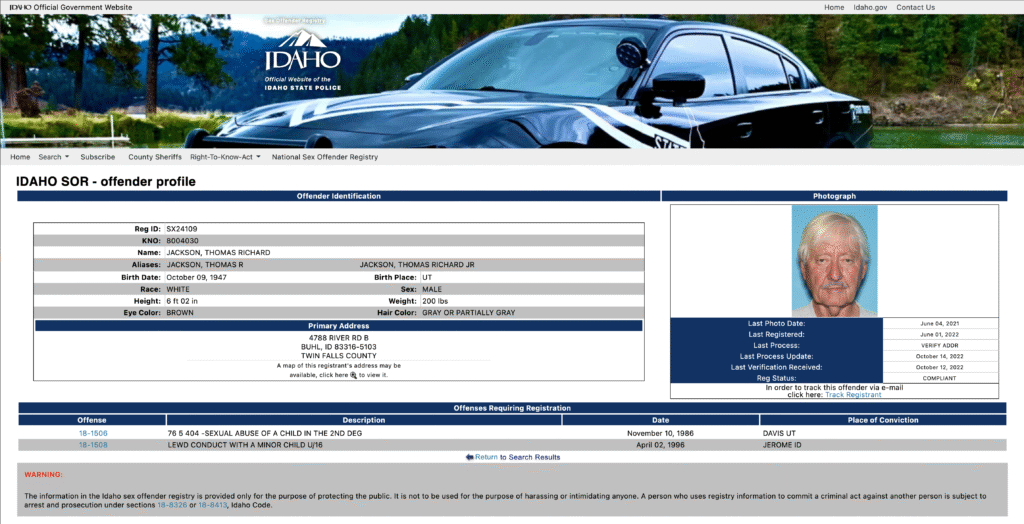
Tom Jackson was still living on that property, near children, when COLD approached him in April of 2023 to request an interview about his work as a police officer on the Nancy Baird cold case. Jackson agreed to an interview about the Baird case, which had long been blamed on serial killer Ted Bundy.
Tom Jackson’s Idaho sex offender registry page, as it appeared when COLD approached Jackson for an interview about the Nancy Baird cold case in February of 2023.
Jackson told COLD he understood his criminal history might make him a suspect in the Baird case.
“I wouldn’t doubt if I was a suspect and all that, and that’s ok with me,” Jackson said.
The Idaho Department of Correction required Jackson to undergo annual polygraph examinations as part of his parole supervision. Jackson said the polygraph examiner always asked a full disclosure question. The gist of that question was, are there any other crimes which you’ve committed which you have not yet confessed?
“I says, ‘I’m guilty of only what I have confessed to,’” Jackson said. “I don’t want you to see me, as some people do, as a vulgar, insensitive, child molesting, blah, blah, blah kind of person. I’ve proven to ‘em on my polygraph that I’m not that person.”
Former East Layton police officer Tom Jackson, one of the initial investigators on Nancy Perry Baird’s disappearance, only worked as a cop a little over a year.
Jackson hired on as a part-time reserve officer in April of 1975, about three months before Nancy Baird vanished. He attended Utah’s police academy starting that September. By the following spring, East Layton’s city council was telling the police chief to place Jackson on probation for undisclosed misconduct.
“I heard that people liked me as an officer there, but I didn’t like being one,” Jackson said during at interview with COLD in April of 2023. “At that time I don’t think I was, I don’t know. I wasn’t a good cop.”
So, Jackson’s short-lived stint as a police officer came to an end on July 20, 1976, when he resigned.
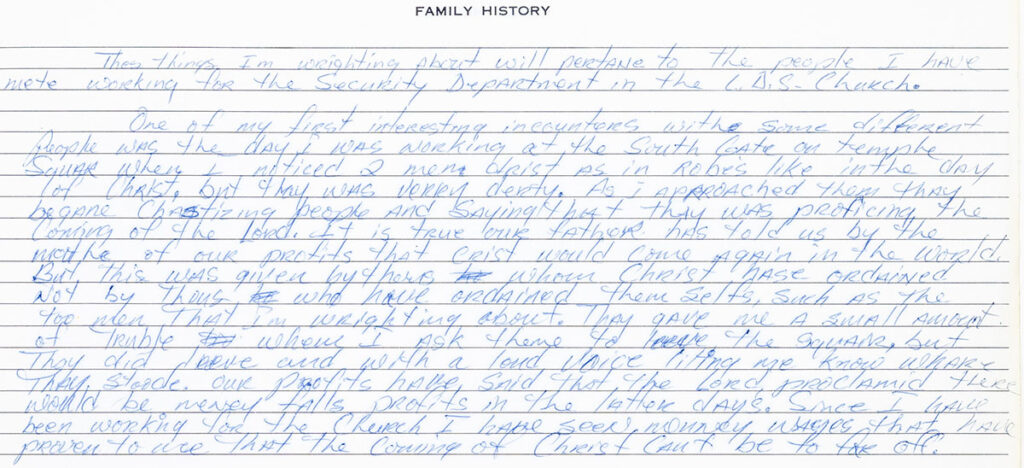
Over the years that followed, Jackson bounced from job to job. He took a position doing private security for the Church of Jesus Christ of Latter-day Saints, as well as an undercover investigator role with the company Northwest Pipeline.
An excerpt from Thomas Jackson’s “book of remembrance” in which Tom wrote about his experiences working security for the Church of Jesus Christ of Latter-day Saints during the late 1970s. Photo: courtesy Tom Jackson family
In 1980, the Northwest Pipeline job introduced Jackson to a young man named James Hydrick who claimed to have telekinetic powers.
The rise and fall of James Hydrick
Hydrick had arrived in Utah from California telling a wild story about his past, including that he’d been raised in a Tibetan monastery by a monk who trained Hydrick to be an assassin. A lawyer who worked for Northwest Pipeline took Hydrick in, giving Hydrick free room and board while the mercurial martial artist wowed the lawyer’s family with demonstrations of his “powers.”
James Hydrick also showed off his impressive physical skills and apparent ability to move objects without touching them to reporters at the Salt Lake Tribune and KSL-TV. The Tribune’s story received wide syndication, republished in newspapers all across the United States. KSL’s video caught the attention of producers at national TV shows such at Ripley’s Believe it or Not and That’s Incredible.
The fall from grace for Hydrick came almost as quickly. In late 1981, independent journalist and magician Dan Korem released a scathing documentary titled Psychic Confession that proved Hydrick’s alleged telekinetic powers were bogus. Korem reverse-engineered each of Hydrick’s feats and demonstrated how they were artful illusions.
At the same time, Salt Lake City police were investigating Hydrick on suspicion the martial artist had coerced several young boys to burglarize homes and steal guns, electronics and other property. Hydrick took a plea deal to criminal charges in 1982 but while serving a prison sentence escaped and went on the run.
An FBI manhunt brought agents to South Carolina, where Hydrick had actually spent his youth in a series of foster homes and at the Whitten Center. As agents closed in, Hydrick surrendered.
Tom Jackson and James Hydrick
James Hydrick’s connection to former East Layton police officer Tom Jackson has never previously been documented or explored.
Jackson’s ex-wife, Geraldine O’Farrell, and several of Jackson’s children told COLD they remember Hydrick visiting their home during the early 1980s. Hydrick took a particular interest in Jackson’s oldest son, Jason, who was at the time in elementary school.
“Tom was interested in martial arts,” Geraldine said. “Tom started taking lessons from James Hydrick. He loved the guy.”
Geraldine recalled that one time, prior to Hydrick’s arrest in Utah, Hydrick asked to sleep over at the Jackson home, in the bedroom of Tom and Geraldine’s son Jason.
Hydrick, Geraldine said, “said he was afraid of the dark.” She refused to allow Hydrick to share a bedroom with her son.
In 1989, Hydrick pleaded guilty to felony charges of child molestation in California, where police alleged he’d inappropriately touched multiple young boys in exchange for food, drugs and martial arts instruction. A judge sentenced Hydrick to 17 years in prison.
Former officer Tom Jackson, it would turn out, also landed in legal trouble during the 1980s for child sex offenses. In August of 1986, the Davis County, Utah Attorney’s Office charged Jackson with two felony counts of sexual abuse of a child.
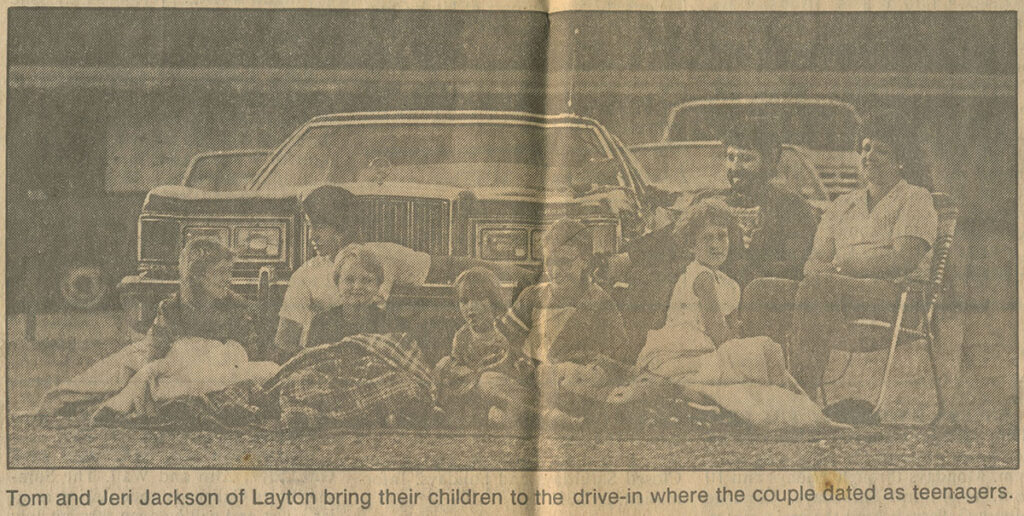
The case did not make the news at the time, which was ironic considering the Ogden Standard-Examiner had photographed and quoted Jackson just a short time earlier, in a feature article about the popularity of drive-in movie theaters.
The Ogden Standard-Examiner photographed Tom and Geraldine Jackson’s family at a drive-in movie theater during the summer of 1986. Jackson was at the time abusing his daughters, Heidi and Tori. Photo: Ogden Standard-Examiner
Journalistic ethics typically preclude reporters from publicly identifying victims in child sex abuse cases. However, Tom Jackson’s victims from his 1986 arrest have agreed to forego their anonymity for COLD. Those victims, perhaps better described as survivors, are Jackson’s daughters, Heidi Holmberg and Tori Riddle.
“It never felt like danger. It felt wrong,” Tori said. “We knew something was wrong and we would say something sometimes. And when I would say something, he’d say, ‘Oh, you’re just so sweet. And Heavenly Father sent you to me so you could help keep me good.’”
The two sisters are speaking out about their father’s abuse, in part to encourage other silenced survivors of child sex abuse but also to raise the question about whether their father’s past abuse might also make him a suspect in the unsolved disappearance of Nancy Baird.
“It’s a hard thing to talk about,” Heidi said, “but it just goes to show that you need to, you need to talk about it.”
Episode credits Research, writing and hosting: Dave Cawley Audio production and mastering: Aaron Mason Cold main score composition: Michael Bahnmiller KSL executive producer: Sheryl Worsley Episode transcript:
Nancy Perry Baird disappeared from the Fina-brand gas station where she worked on the afternoon of July 4, 1975. The station sat on the west side of U.S. Highway 89, near the intersection with Cherry Lane, in the quiet community of East Layton, Utah.
Baird, a 23-year-old divorcee with a 4-year-old son, was scheduled to staff the self-serve station along from 3 p.m. to midnight on that Independence Day. But when the station’s manager, Bonnie Peck, stopped in to the business a little after 5:30 p.m., she found several patrons waiting to pay. Baird, the clerk, was nowhere to be found.
Nancy Baird’s wallet, purse, keys and car were all still at the station. There were no signs of a struggle inside the store, no money missing from the cash register. Police quickly concluded Nancy Baird had not left of her own accord. The most obvious reason why: Baird’s son, Brant, was also left behind, in the care of her parents.
Nancy Perry Baird’s son, Brant Baird, holds his missing mother’s wallet at the site where she was last seen on July 4, 1975. The gas station where Nancy Baird worked has since been torn down. Photo: Dave Cawley, KSL Podcasts
A few days later, a reporter for KSL-TV stood in front of the Fina station clutching a microphone. Looking into the lens, he said “there is a wrinkle in this case that might relate to another.”
The Fina station was owned by a company called Tri-angle Oil. One of the co-owners of that business was a man named Dean Kent, whose 17-year-old daughter Debra Kent had disappeared the prior November.
“When asked about this coincidence, police said it was nothing more than just a coincidence,” reporter Steve Schwartz said, “but the investigation goes on.”
The Ted Bundy coincidence
Police across Utah were at the time in the summer of 1975 operating under the belief a serial killer was in active in their communities. That suspicion proved true. Weeks after Nancy Baird vanished, a state trooper made the first arrest of a man named Theodore “Ted” Bundy.
Bundy, it would later be proved, had abducted and murdered Debra Kent. The notorious serial killer admitted to that killing in an audiotaped interview two days prior to his execution in 1989. But during that same conversation with a detective, Bundy denied abducting Nancy Baird.
“Nancy Baird, who’s that,” Bundy said. “No, I didn’t have anything to do with that disappearance.”
Ted Bundy was telling the truth. Research by Tiffany Jean from the blog Killer in the Archives later revealed Bundy was 100 miles away from East Layton on the day Nancy Baird disappeared.
COLD first shared that information in a May, 2023 bonus episode of season 3 titled “The Convenient Alternative.” The news of Bundy’s unexpected alibi reached Nancy Baird’s son, Brant, who had lived his life up to that point believing Bundy had killed his mom.
Nancy Baird’s childhood friend
The bonus episode also had a profound impact on the family of a former East Layton police officer who’d worked the Nancy Baird case, right from the first night. COLD interviewed that former officer, Thomas Richard Jackson, as part of the reporting process for the bonus episode. Jackson was, at the time in 2023, a registered sex offender living on parole in southern Idaho.
Jackson acknowledged at that time he might be a suspect. He’d been married to one of Nancy Perry Baird’s childhood friends at the time of Baird’s disappearance. That woman, Geraldine O’Farrell, recalled learning from her ex-husband that Baird was missing.
“He knew I had been friends with her,” Geraldine said in an exclusive interview with COLD.
Geraldine and another girl, Shelley Williams, had been close with Nancy Perry (later Baird) during their junior high years. The trio spent their time rollerskating at the Berthana in Ogden, or flirting with boys at the Lagoon amusement park.
This photobooth image taken at the Lagoon amusement park shows Nancy Perry (right), Geraldine Fikstad (center) and Shelley Williams (left) during the peak of their childhood friendship. Photo: courtesy Brant Baird
But Geraldine was ousted from the friendship at age 14, when she got into an argument with Shelley and Nancy at Lagoon one day about calling home to check in with their parents.
“I had a set time I had to call,” Geraldine said. “They didn’t want to go home then so they told me not to call.”
Geraldine’s ouster from the friendship left her feeling a profound sense of loneliness. Thomas Jackson, an older neighbor boy, took notice of her soon after.
This 1967 Polaroid photo shows Thomas Richard Jackson at Ft. Sill, Oklahoma during Jackson’s service in the U.S. Army. Photo: courtesy Tom Jackson family
“He was in the Army and had already served his time and was out,” Geraldine said. “So he was a lot older than me.”
Nancy and Dee Baird
Nancy Perry, meanwhile, soon began dating the man who would later become her husband, Dee Baird. Nancy and Dee wed in 1970, toward the end of Nancy’s senior year of high school, and welcomed their son Brant the following October.
Nancy Perry Baird and Dee Baird are pictured in a candid moment from their wedding day, April 9, 1970. Photo: courtesy Brant Baird
The marriage lasted three years before Dee filed for divorce in the summer of 1973. The divorce proceeded quickly, with Nancy signing the papers weeks later.
After Nancy Baird vanished two years later, police case files show detectives at first investigated whether her ex-husband, Dee Baird, might’ve been responsible. But Nancy and Dee had remained amicable after their split, even dating on occasion. Dee Baird also had a solid alibi for the date of his ex-wife’s disappearance: he’d been in the vicinity of Jackson Hole, Wyoming with friends who vouched for his location.
Nancy’s job at the Fina station put her in constant contact with the officers of the little police department in the town of East Layton. One of them, David Ray Anderson, was among the last people to have seen Nancy alive on that July 4th afternoon.
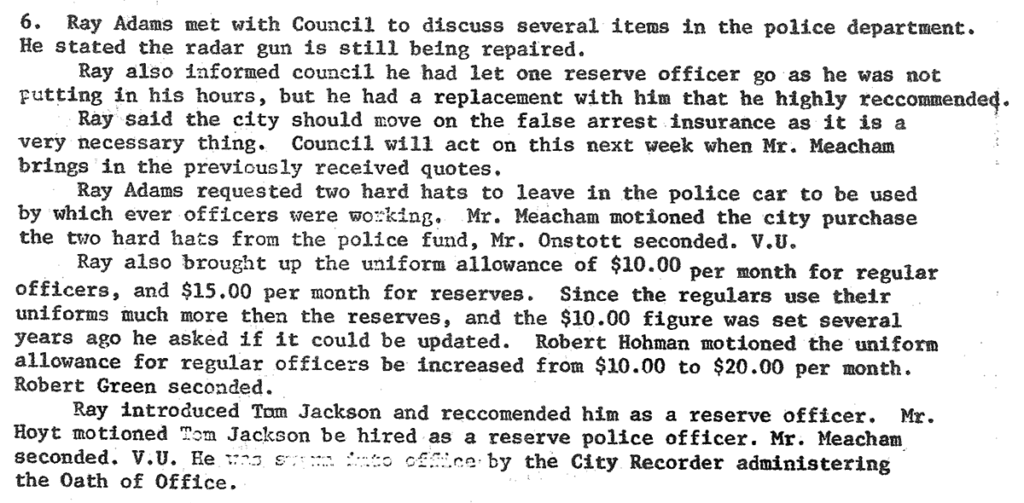
East Layton City Council minutes obtained by COLD through an open records request revealed the then-husband of Nancy’s former friend, Geraldine, had signed on as a part-time reserve officer for East Layton just a few months earlier, in April of 1975.
East Layton City Council minutes from April 8, 1975 record reserve officer Tom Jackson’s hiring. Jackson later attended Utah’s police academy and became East Layton’s lone full-time officer.
Thomas “Tom” Jackson is identified in the Nancy Baird case files by the callsign E-4. Geraldine O’Farrell told COLD she believes Jackson might’ve talked to Nancy Baird on the day of Nancy’s disappearance.
“I’m sure he flirted with Nancy, I’m sure he did,” Geraldine said. “He’s a police officer, they probably all were in there flirting with her.”
Today, with Ted Bundy removed from the list of suspects by alibi, Geraldine also wonders if her ex-husband might’ve played an active role in Nancy’s disappearance.
“Five years ago would I have thought he did? Probably no,” Geraldine said. “But now, I don’t know. So much has come out on what he has done.”